
📑 Table of Contents
🔗 Internal Links
In the previous episode, we talked about website speed and its impact on tourist decisions. Today we talk about something simple but with a big impact: Internal links.
Internal links are links that take tourists from one page on your site to another page on the same site. When used correctly, they help tourists discover more content and spend more time on your site.
🔗 Why are internal links important?
- 🔹 Help tourists discover more content
- 🔹 Keep them on your site longer
- 🔹 Help Google understand your site structure
- 🔹 Transfer SEO value between pages
- 🔹 Help tourists find information easily
📌 The Golden Rule
Internal links should be:
- ✅ Natural and useful — Not forced, providing real value
- ✅ Pointing to relevant content — The linked page should be related
- ✅ Using clear anchor text — "Click here" is not good, use descriptive text
- ✅ Making information easy to find — Without requiring too much searching
📊 Types of Internal Links
- Navigation links: Main menu, submenu, footer links
- In-content links: Natural links within articles
- Related content links: "Similar articles", "You may also like"
- Category links: Blog categories, tags
- Important page links: Leading to contact, booking pages, etc.
📊 Example: How to use internal links?
In a blog post:
- In an article about "Where to stay in Istanbul", add a link to the rooms page:
- "Discover our luxury rooms designed specifically for an unforgettable stay."
On the rooms page:
- Add a link to the Istanbul guide:
- "After booking, check out our Istanbul travel guide to plan your trip."
🏨 Practical Example from Hosanat
On the Hosanat website, we used internal links to:
- Connect blog articles — Each article links to other related articles
- Guide tourists from the home page to rooms — Easy access to rooms
- Make services and information easily accessible — Important links on every page
This helped tourists stay on the site and explore more.
💡 Important Tip
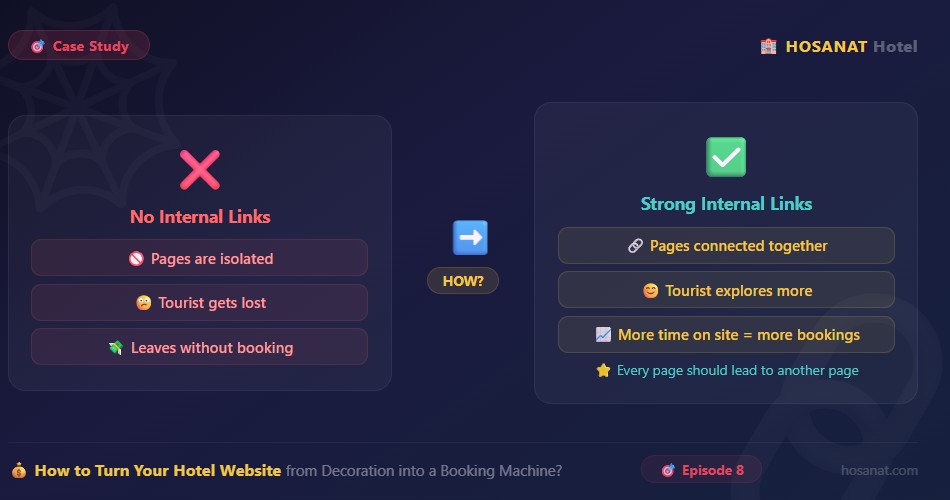
Every page on your site should connect to other pages. Tourists who enter from any page should find a way to continue exploring.
Remember: A strong internal link structure = longer stay = higher chance of booking.
📈 Summary
Internal links are the pathways of your site. When used correctly, they improve tourist experience and help with SEO.
In the next episode, we will talk about user experience (UX).
— Tarek Fahmy, Digital Marketing & SEO Expert
Comments (0)
Leave a Comment
You must login to comment.
No comments yet. Be the first to comment!