
📑 Table of Contents
- 🥗 Salad Bowls: A Comprehensive Buyer's Guide
- 🥗 1. What Is a Salad Bowl?
- Key Characteristics
- Where Is It Used?
- 📏 2. Salad Bowl Sizes
- Which Size to Choose?
- 🔍 3. Clear Lid: Displaying the Product
- Lid Types
- Clear Lid Test
- 🌿 4. Freshness Preservation: Critical for Salad
- Freshness Preservation Factors
- Freshness Test
- 🔧 5. Technical Specs: What to Look For When Choosing?
- Grammage
- Inner Coating
- Lid Compatibility
- Printing
- Certifications
- 💰 6. Salad Bowl Prices (2026)
- Factors Affecting Price
- ⚠️ 7. Common Mistakes When Buying Salad Bowls
- ❓ 8. Frequently Asked Questions
- Is a salad bowl suitable for salad?
- Is the lid included?
- Which grammage should I choose?
- Clear or opaque lid?
- Can a salad bowl go in the microwave?
- What is the MOQ?
- Can I get a sample?
- How long does delivery take?
- 🚀 9. Summary: Salad Bowl Selection Checklist
- Salad Bowls
🥗 Salad Bowls: A Comprehensive Buyer's Guide
Salad, poke bowl, granola, dessert — there's an ideal paper bowl for each: the salad bowl. With its wide mouth, shallow depth, and clear lid, it displays the product, preserves freshness, and offers a perfect takeaway solution. But "salad bowl" doesn't mean "all salad bowls are the same." Differences in grammage, coating, lid compatibility, freshness preservation, and printing create significant quality gaps between two bowls that look identical. In this guide, we'll walk you through everything you need to know about salad bowls — what they are, available sizes, why a clear lid matters, how freshness is preserved, how to choose, prices, and common mistakes — step by step.
This is not an advertisement — it's a practical guide. At the end, if you find that Dam Cups Group suits you, there's a link. If not, you've learned how to buy wisely from another supplier.
🥗 1. What Is a Salad Bowl?
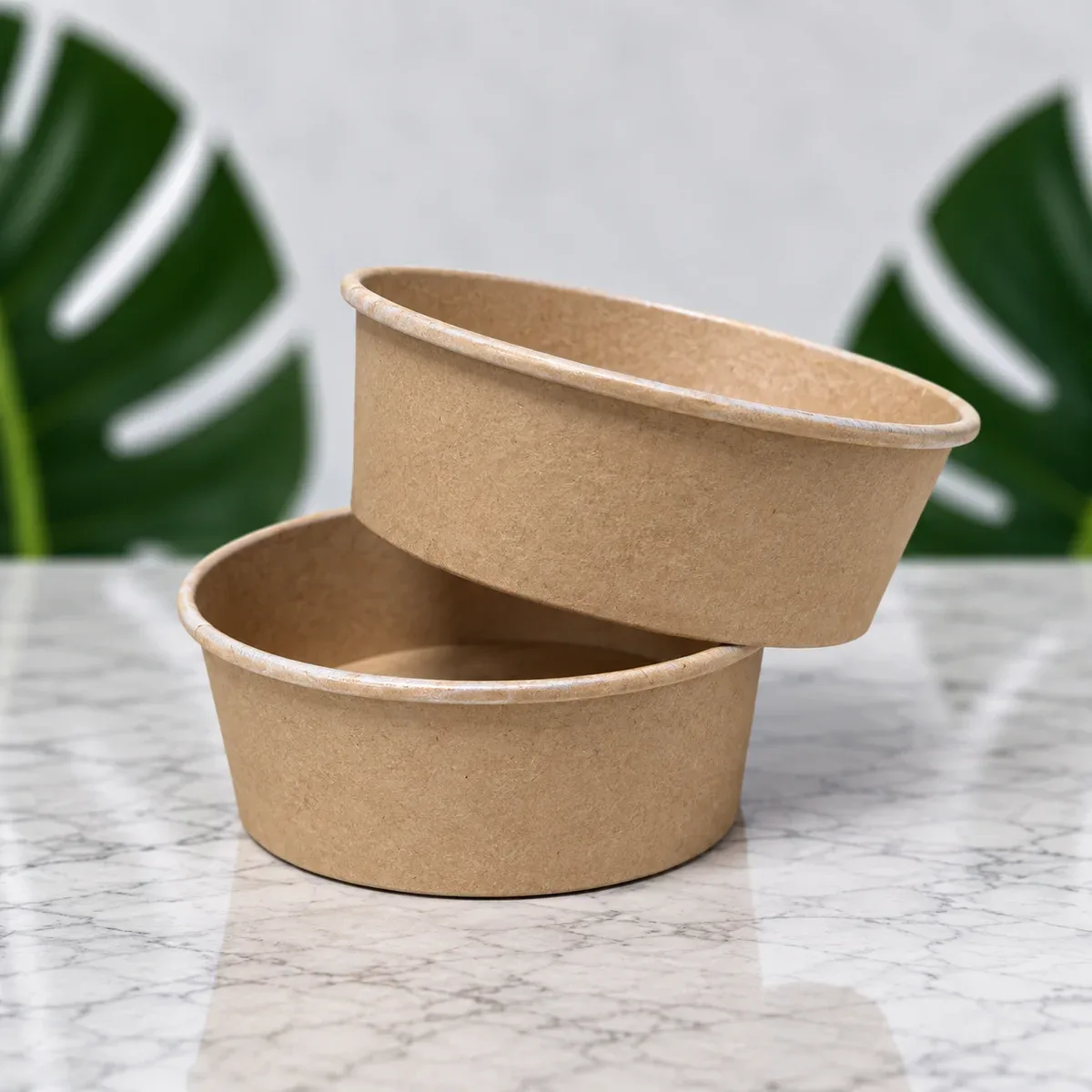
A salad bowl is a paper bowl with a wide mouth and shallow depth, designed for fresh foods. It's usually single wall, with the inner surface coated with PE or PLA. When used with a clear lid, it displays the product and preserves freshness.
Key Characteristics
| Characteristic | Details |
|---|---|
| Structure | Single wall paper + inner coating (PE/PLA) |
| Grammage | 250–300 gsm (common: 260–280 gsm) |
| Sizes | 20 oz – 26 oz (common) |
| Usage | Salad, poke bowl, granola, dessert |
| Lid | Clear or opaque |
| Leak resistance | Medium (sufficient for salad dressing) |
| Freshness preservation | High (with clear lid) |
Where Is It Used?
- Restaurants: Salad, poke bowl, grain bowl
- Cafés: Granola, yogurt, dessert
- Takeaway: Salad, healthy food
- Supermarket: Ready salad, deli
- Airport: Healthy fast food
- Gym: Protein bowl, diet
📏 2. Salad Bowl Sizes
Salad bowls are typically produced from 20 oz to 26 oz. Here are the common sizes:
| Size | Volume (cc) | Top Diameter (mm) | Height (mm) | Bottom Diameter (mm) | Usage |
|---|---|---|---|---|---|
| 20 oz | 550 | 125 | 52 | 105 | Small salad, granola |
| 26 oz | 750 | 145 | 68 | 125 | Large salad, poke bowl |
| 32 oz | 1100 | 165 | 75 | 145 | Sharing, family portion |
Which Size to Choose?
- Small salad / granola: 20 oz
- Standard salad / poke bowl: 26 oz
- Large portion / sharing: 32 oz
Tip: Most restaurants need 20 and 26 oz. 32 oz is ideal for sharing or family portions.
🔍 3. Clear Lid: Displaying the Product
The most important feature of a salad bowl is the clear lid. It displays the product, opens the appetite, and highlights freshness. Here are the lid types:
Lid Types
| Lid Type | Feature | Best For |
|---|---|---|
| Clear Flat Lid | Shows the product | Salad, poke bowl |
| Clear Dome Lid | Tall, spacious | Large portion, granola |
| Opaque Lid | Hides the product | Hot food, soup |
| Paper Lid | Eco-friendly | Short transport |
Clear Lid Test
- Attach the lid to the bowl.
- Turn the bowl upside down.
- Wait 30 seconds.
- Does the lid loosen? If not, it's compatible.
- Does it leak? Light leak resistance is enough for salad dressing.
Tip: A clear lid increases product visibility and boosts customer satisfaction. Especially important for takeaway and delivery.
🌿 4. Freshness Preservation: Critical for Salad
Salad is served fresh — the bowl must preserve that. Here are the factors that determine freshness:
Freshness Preservation Factors
- Clear lid: Shows the product, highlights freshness
- Leak resistance: Prevents salad dressing from leaking
- Inner coating: Retains moisture and oil (PE/PLA)
- Grammage: Higher grammage = better protection
- Ventilation: Some lids breathe (ideal for salad)
Freshness Test
- Fill the sample with salad.
- Attach the lid.
- Wait 2 hours.
- Is the salad still fresh?
- Does the lid fog up? Light fogging is normal.
Tip: A clear lid increases salad visibility and gives the customer a freshness message.
🔧 5. Technical Specs: What to Look For When Choosing?
Grammage
- 250–270 gsm: Economical, short-term use
- 270–300 gsm: Standard, daily use (most common)
- 300–350 gsm: Premium, for heavy salad
Inner Coating
- PE (Polyethylene): Most common, water/oil resistant, economical
- PLA (Polylactic Acid): Biodegradable, eco-friendly, more expensive
Lid Compatibility
- Clear flat lid: Ideal for salad
- Clear dome lid: For large portions
- Test: Turn upside down, shake, no loosening
Printing
- Unprinted: Most economical
- Flexo: 2–4 colors, large volume
- Offset: 6+ colors, high quality
- Note: Salad bowls are usually printed on the outer surface
Certifications
- FSC: Sustainable paper
- ISO 22000: Food safety
- HACCP: Food safety control points
- FDA / LFGB: Food contact compliance
💰 6. Salad Bowl Prices (2026)
The prices below are estimates and vary with market conditions. Always request a current quote for exact pricing.
| Size | Unprinted (1,000 units) | Single Color (1,000 units) | Multi-Color (10,000 units) |
|---|---|---|---|
| 20 oz | $40 – $55 | $50 – $70 | $45 – $60 |
| 26 oz | $45 – $65 | $55 – $80 | $50 – $70 |
| 32 oz | $50 – $75 | $65 – $90 | $55 – $80 |
Note: Prices are FOB Turkey. Shipping, customs, and insurance are excluded. Lid price is usually separate.
Factors Affecting Price
- Grammage: Higher grammage = higher price
- Size: Larger size = higher price
- Lid: Clear lid = extra cost
- Printing: More colors = higher price
- Quantity: Larger quantity = lower unit price
- Coating: PLA is more expensive than PE
⚠️ 7. Common Mistakes When Buying Salad Bowls
- Not choosing a clear lid. If the product isn't visible, the freshness message is lost.
- Not testing lid compatibility. If the lid loosens, transport becomes a problem.
- Not testing leak resistance. Salad dressing may leak.
- Not checking grammage. Big difference between 250 and 300 gsm.
- Choosing the wrong size. A 20 oz bowl doesn't fit a 26 oz salad.
- Not ordering the lid separately. Lids are usually sold separately — add to the budget.
- Not testing freshness preservation. Is the salad still fresh after 2 hours?
- Not asking about coating. PE or PLA?
- Not asking about certificates. If there's no FSC or ISO 22000, customs problems.
- Not requesting a sample. The sample confirms quality.
❓ 8. Frequently Asked Questions
Is a salad bowl suitable for salad?
Yes, salad bowls are specifically designed for fresh foods. They must be used with a clear lid.
Is the lid included?
Usually no. The lid is sold separately. Add it to your order.
Which grammage should I choose?
For daily use, 270–300 gsm is ideal. For heavy salad, 300–350 gsm. For economical solutions, 250–270 gsm.
Clear or opaque lid?
For salad, a clear lid is ideal (shows the product, highlights freshness). For hot food, an opaque lid is more suitable.
Can a salad bowl go in the microwave?
PE coating is usually microwave-safe. But ask the manufacturer. PLA coating may not be microwave-safe.
What is the MOQ?
Unprinted: 1,000+. Single color: 5,000+. Multi-color: 10,000+. Offset: 20,000+.
Can I get a sample?
Yes, always request a physical sample on the first order. Test it with the lid.
How long does delivery take?
Production: 15–30 days. Shipping: 3–30 days depending on destination.
🚀 9. Summary: Salad Bowl Selection Checklist
- ☐ Define the need: Salad, poke bowl, granola?
- ☐ Choose sizes: 20, 26, 32 oz — how many?
- ☐ Determine grammage: Between 250–350 gsm
- ☐ Choose coating: PE (economical) or PLA (eco-friendly)
- ☐ Choose a clear lid: Shows the product
- ☐ Test lid compatibility: No loosening
- ☐ Test leak resistance: Sufficient for salad dressing
- ☐ Test freshness preservation: Fresh after 2 hours?
- ☐ Request certificates: FSC, ISO 22000, HACCP
- ☐ Request quotes: From 3–5 suppliers (including lid)
- ☐ Request a sample: Always on the first order
- ☐ Sign the contract: Specification, Incoterms, penalty clauses
Salad Bowls
View product details: 20 oz, 26 oz, and 32 oz salad bowls, with clear lids, ready for export and wholesale.
Salad Bowl Details— This guide is part of the "Importing Paper Cups and Bowls from Turkey" series — a series of articles aimed at helping importers, restaurants, and distributors make better purchasing decisions.
Comments (0)
Leave a Comment
You must login to comment.
No comments yet. Be the first to comment!