
📑 Table of Contents
- 🍲 Soup Bowls: A Comprehensive Buyer's Guide
- 🍲 1. What Is a Soup Bowl?
- Key Characteristics
- Where Is It Used?
- 📏 2. Soup Bowl Sizes
- Which Size to Choose?
- 🔒 3. Lid Compatibility: The Most Critical Feature
- Lid Types
- Lid Test (Critical)
- 💧 4. Leak Resistance: Essential for Soup
- Leak Resistance Factors
- Leak Resistance Test (Mandatory)
- 🌡️ 5. Thermal Insulation: Soup Must Stay Hot
- Thermal Insulation Factors
- Single Wall vs Double Wall Soup Bowl
- 🔧 6. Technical Specs: What to Look For When Choosing?
- Grammage
- Inner Coating
- Lid Compatibility
- Printing
- Certifications
- 💰 7. Soup Bowl Prices (2026)
- Factors Affecting Price
- ⚠️ 8. Common Mistakes When Buying Soup Bowls
- ❓ 9. Frequently Asked Questions
- Is a soup bowl suitable for soup?
- Is the lid included?
- Which grammage should I choose?
- Single or double wall?
- Can a soup bowl go in the microwave?
- What is the MOQ?
- Can I get a sample?
- How long does delivery take?
- 🚀 10. Summary: Soup Bowl Selection Checklist
- Soup Bowls
🍲 Soup Bowls: A Comprehensive Buyer's Guide
Soup is one of the most consumed foods in the world — and in the takeaway world, one of the most challenging. Hot, liquid, requiring leak resistance. That's why soup bowls have different characteristics from other paper bowls: higher grammage, better leak resistance, heat retention, leak-proof lid. In this guide, we'll walk you through everything you need to know about soup bowls — what they are, available sizes, lid compatibility, leak testing, heat retention, how to choose, prices, and common mistakes — step by step.
This is not an advertisement — it's a practical guide. At the end, if you find that Dam Cups Group suits you, there's a link. If not, you've learned how to buy wisely from another supplier.
🍲 1. What Is a Soup Bowl?
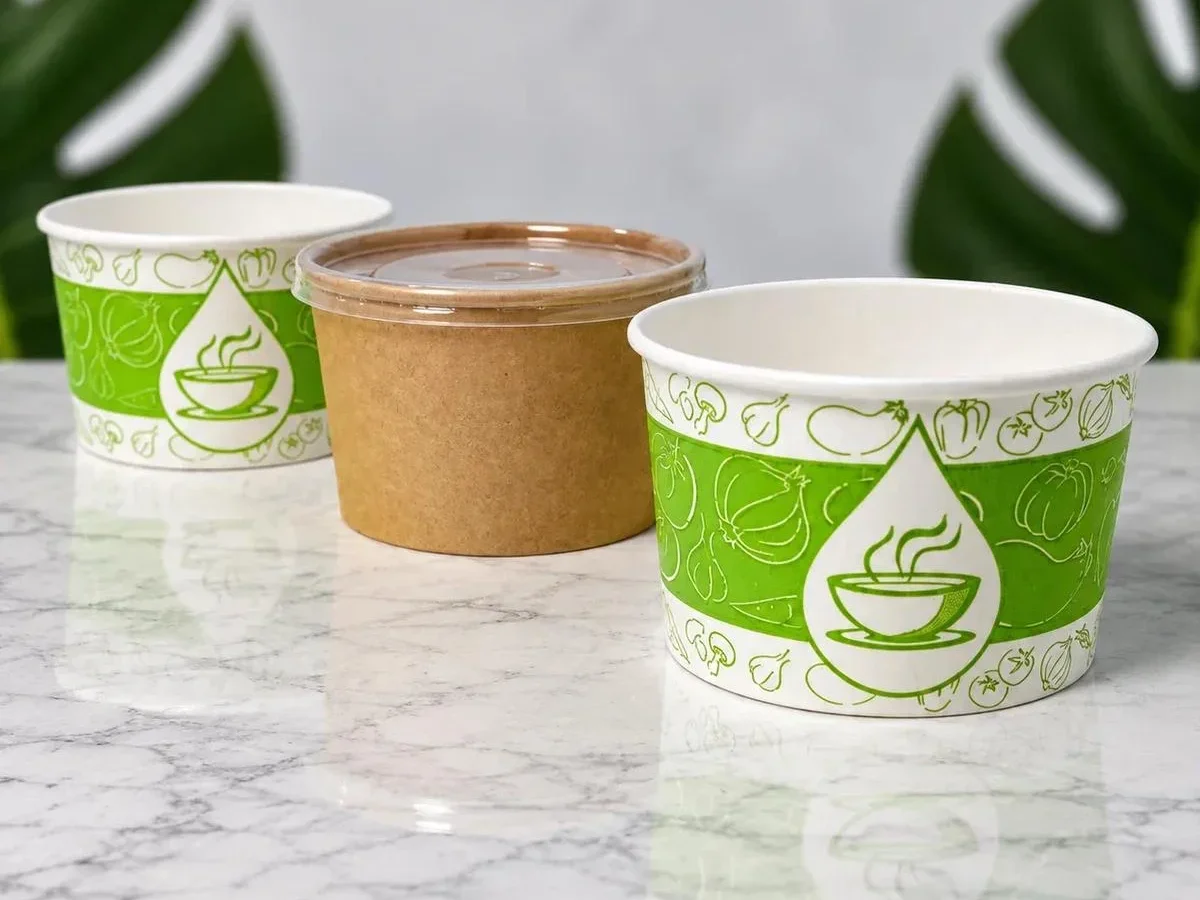
A soup bowl is a deep, leak-resistant paper bowl specifically designed for hot and liquid foods. It's usually single or double wall, with the inner surface coated with PE or PLA. It's used with a leak-proof lid.
Key Characteristics
| Characteristic | Details |
|---|---|
| Structure | Single or double wall paper + inner coating (PE/PLA) |
| Grammage | 250–350 gsm (common: 280–320 gsm) |
| Sizes | 12 oz – 16 oz (common) |
| Usage | Soup, noodles, rice, stew |
| Lid | Leak-proof lid (usually not included) |
| Leak resistance | Very high (essential) |
| Thermal insulation | High (heat retention) |
Where Is It Used?
- Restaurants: Soup, stew, noodles
- Takeaway: Soup, rice, stew
- Catering: Events, meetings, weddings
- Hospitals: Patient meals, diet
- Schools: Canteens, cafeterias
- Airport: Fast food, takeaway
📏 2. Soup Bowl Sizes
Soup bowls are typically produced from 12 oz to 16 oz. Here are the common sizes:
| Size | Volume (cc) | Top Diameter (mm) | Height (mm) | Bottom Diameter (mm) | Usage |
|---|---|---|---|---|---|
| 12 oz | 350 | 100 | 55 | 78 | Small soup, appetizer |
| 16 oz | 470 | 110 | 67 | 95 | Standard soup, rice |
| 20 oz | 550 | 125 | 75 | 105 | Large soup, stew |
Which Size to Choose?
- Appetizer soup: 12 oz
- Standard soup: 16 oz
- Large portion / main course: 20 oz
Tip: Most restaurants need 12 and 16 oz. 20 oz is ideal for large portions.
🔒 3. Lid Compatibility: The Most Critical Feature
For a soup bowl to work, a leak-proof lid is essential. Without a lid, soup can't be transported. Here are the lid types:
Lid Types
| Lid Type | Feature | Best For |
|---|---|---|
| Flat Leak-Proof Lid | Plastic, leak-proof | Soup, stew |
| Dome Lid | Tall, spacious | Large portion, noodles |
| Clear Lid | Shows the product | Salad, dessert |
| Paper Lid | Eco-friendly | Short transport |
Lid Test (Critical)
- Attach the lid to the bowl.
- Turn the bowl upside down.
- Wait 30 seconds.
- Is there a leak? If not, the lid is compatible.
- Shake it. The lid should not loosen.
Warning: Lid compatibility must be tested with the bowl itself. Lids from different manufacturers may not fit.
💧 4. Leak Resistance: Essential for Soup
Soup is liquid — without leak resistance, it can't be transported. Here are the factors that determine leak resistance:
Leak Resistance Factors
- Bottom edge gluing: Prevents leaks
- Inner coating: Holds the liquid (PE/PLA)
- Paper thickness: Higher grammage = better leak resistance
- Lid compatibility: Leak-proof lid is essential
- Gluing quality: Good gluing = no separation
Leak Resistance Test (Mandatory)
- Fill the sample with 90°C water.
- Attach the lid.
- Wait 30 minutes.
- Turn upside down, shake.
- Is there a leak? If not, the bowl is suitable.
Tip: Do the leak resistance test in your own kitchen. Photograph the results. This is evidence when talking to the supplier.
🌡️ 5. Thermal Insulation: Soup Must Stay Hot
Soup is served hot — the bowl must preserve that. Here are the factors that determine thermal insulation:
Thermal Insulation Factors
- Grammage: Higher grammage = better insulation
- Structure: Double wall = better insulation (but more expensive)
- Lid: Leak-proof lid = reduces heat loss
- Coating: PE/PLA = retains heat
Single Wall vs Double Wall Soup Bowl
| Criterion | Single Wall | Double Wall |
|---|---|---|
| Thermal insulation | Medium | High |
| Cost | Economical | 30–50% more expensive |
| Usage | Short distance | Long distance, heat retention |
| Best for | Restaurant, quick service | Takeaway, catering |
Recommendation: For takeaway, double wall is better (soup stays hot). For in-restaurant service, single wall is sufficient.
🔧 6. Technical Specs: What to Look For When Choosing?
Grammage
- 250–280 gsm: Economical, short-term use
- 280–320 gsm: Standard, daily use (most common)
- 320–350 gsm: Premium, for heavy soup
Inner Coating
- PE (Polyethylene): Most common, waterproof, economical
- PLA (Polylactic Acid): Biodegradable, eco-friendly, more expensive
Lid Compatibility
- Leak-proof lid: Essential
- Dome lid: For large portions
- Test: Turn upside down, shake, no leak
Printing
- Unprinted: Most economical
- Flexo: 2–4 colors, large volume
- Offset: 6+ colors, high quality
Certifications
- FSC: Sustainable paper
- ISO 22000: Food safety
- HACCP: Food safety control points
- FDA / LFGB: Food contact compliance
💰 7. Soup Bowl Prices (2026)
The prices below are estimates and vary with market conditions. Always request a current quote for exact pricing.
| Size | Unprinted (1,000 units) | Single Color (1,000 units) | Multi-Color (10,000 units) |
|---|---|---|---|
| 12 oz | $30 – $45 | $40 – $55 | $35 – $50 |
| 16 oz | $35 – $50 | $45 – $65 | $40 – $55 |
| 20 oz | $40 – $60 | $50 – $70 | $45 – $65 |
Note: Prices are FOB Turkey. Shipping, customs, and insurance are excluded. Lid price is usually separate.
Factors Affecting Price
- Grammage: Higher grammage = higher price
- Size: Larger size = higher price
- Structure: Double wall = more expensive
- Lid: Leak-proof lid = extra cost
- Printing: More colors = higher price
- Quantity: Larger quantity = lower unit price
⚠️ 8. Common Mistakes When Buying Soup Bowls
- Not testing lid compatibility. If the lid leaks, the bowl is useless.
- Not testing leak resistance. Test with 90°C water.
- Not checking grammage. Big difference between 250 and 320 gsm.
- Choosing the wrong size. A 12 oz bowl doesn't fit a 16 oz soup.
- Not ordering the lid separately. Lids are usually sold separately — add to the budget.
- Not testing thermal insulation. Is the soup still hot after 30 minutes?
- Not asking about coating. PE or PLA?
- Not asking about certificates. If there's no FSC or ISO 22000, customs problems.
- Not requesting a sample. The sample confirms quality.
- Not checking MOQ. Small order = higher unit price.
❓ 9. Frequently Asked Questions
Is a soup bowl suitable for soup?
Yes, soup bowls are specifically designed for liquid foods. But they must be used with a leak-proof lid.
Is the lid included?
Usually no. The lid is sold separately. Add it to your order.
Which grammage should I choose?
For daily use, 280–320 gsm is ideal. For heavy soup, 320–350 gsm. For economical solutions, 250–280 gsm.
Single or double wall?
For takeaway, double wall (soup stays hot). For in-restaurant service, single wall is sufficient.
Can a soup bowl go in the microwave?
PE coating is usually microwave-safe. But ask the manufacturer. PLA coating may not be microwave-safe.
What is the MOQ?
Unprinted: 1,000+. Single color: 5,000+. Multi-color: 10,000+. Offset: 20,000+.
Can I get a sample?
Yes, always request a physical sample on the first order. Test it with the lid.
How long does delivery take?
Production: 15–30 days. Shipping: 3–30 days depending on destination.
🚀 10. Summary: Soup Bowl Selection Checklist
- ☐ Define the need: Standard soup or large portion?
- ☐ Choose sizes: 12, 16, 20 oz — how many?
- ☐ Choose structure: Single wall (economical) or double wall (heat retention)
- ☐ Determine grammage: Between 250–350 gsm
- ☐ Choose coating: PE (economical) or PLA (eco-friendly)
- ☐ Test lid compatibility: Leak-proof?
- ☐ Test leak resistance: With 90°C water
- ☐ Test thermal insulation: Hot after 30 minutes?
- ☐ Request certificates: FSC, ISO 22000, HACCP
- ☐ Request quotes: From 3–5 suppliers (including lid)
- ☐ Request a sample: Always on the first order
- ☐ Sign the contract: Specification, Incoterms, penalty clauses
Soup Bowls
View product details: 12 oz, 16 oz, and 20 oz soup bowls, with leak-proof lids, ready for export and wholesale.
Soup Bowl Details— This guide is part of the "Importing Paper Cups and Bowls from Turkey" series — a series of articles aimed at helping importers, restaurants, and distributors make better purchasing decisions.
Comments (0)
Leave a Comment
You must login to comment.
No comments yet. Be the first to comment!