📑 Table of Contents
- 📦 Importing Food Containers from Turkey: The Complete Buyer's Guide
- 🌍 1. Why Food Containers Matter So Much
- Paper Containers: The Ideal Solution for Every Meal
- Plastic Is Retreating — Paper Is Advancing
- Why This Matters for Importers
- 📊 2. Why Turkey? An Honest Comparison
- Why This Matters
- 🔧 3. Technical Specs You Must Know Before Ordering
- Types of Food Containers
- Paper and Cardboard Type
- Inner Coating
- Printing
- Lids
- Certifications
- Sizes
- 🚚 4. The Practical Side: How to Import Smartly
- Shipping — A Smart Comparison
- Essential Documents
- How to Choose the Right Supplier (Checklist)
- ⚠️ 5. Common Mistakes That Cost Importers Money
- ❓ 6. Frequently Asked Questions
- How long does shipping from Turkey take?
- Can I print Arabic on the containers?
- What is the minimum order quantity?
- Is Turkish paper approved for food use?
- Can I get a sample before ordering?
- What's the best payment method?
- Are salad bowls suitable for hot foods?
- Are lids included with the containers?
- 🚀 7. Summary: How to Start
- 📩 For More Information, Contact Us: Paper Port
📦 Importing Food Containers from Turkey: The Complete Buyer's Guide
Turkey has become one of the world's leading hubs for paper packaging exports in recent years. Businesses across Europe, the Middle East, North Africa, and beyond are turning to Turkey for competitive pricing, high-quality manufacturing, and a strategic geographic location. In this guide, we'll walk you through everything you need to know about importing food containers from Turkey — from choosing a supplier to customs, from quality control to shipping — step by step.
This is not an advertisement — it's a practical guide. At the end, if you find that Paper Port suits you, there's a link. If not, you've learned how to choose another supplier wisely.
🌍 1. Why Food Containers Matter So Much
In recent years, the role of the food container in the restaurant and café world has changed. It's no longer just a "container" for food — it has become part of the brand experience. When a customer receives their salad or soup in an elegant container with your logo, you're not just serving a meal — you're delivering a complete experience that stays in their memory.
This shift is driven by several factors:
- Healthy food culture: Especially with the rise of salad and bowl restaurants.
- Delivery: Which made containers a necessity, not a luxury.
- Consumer awareness: Growing interest in sustainable packaging.
Paper Containers: The Ideal Solution for Every Meal
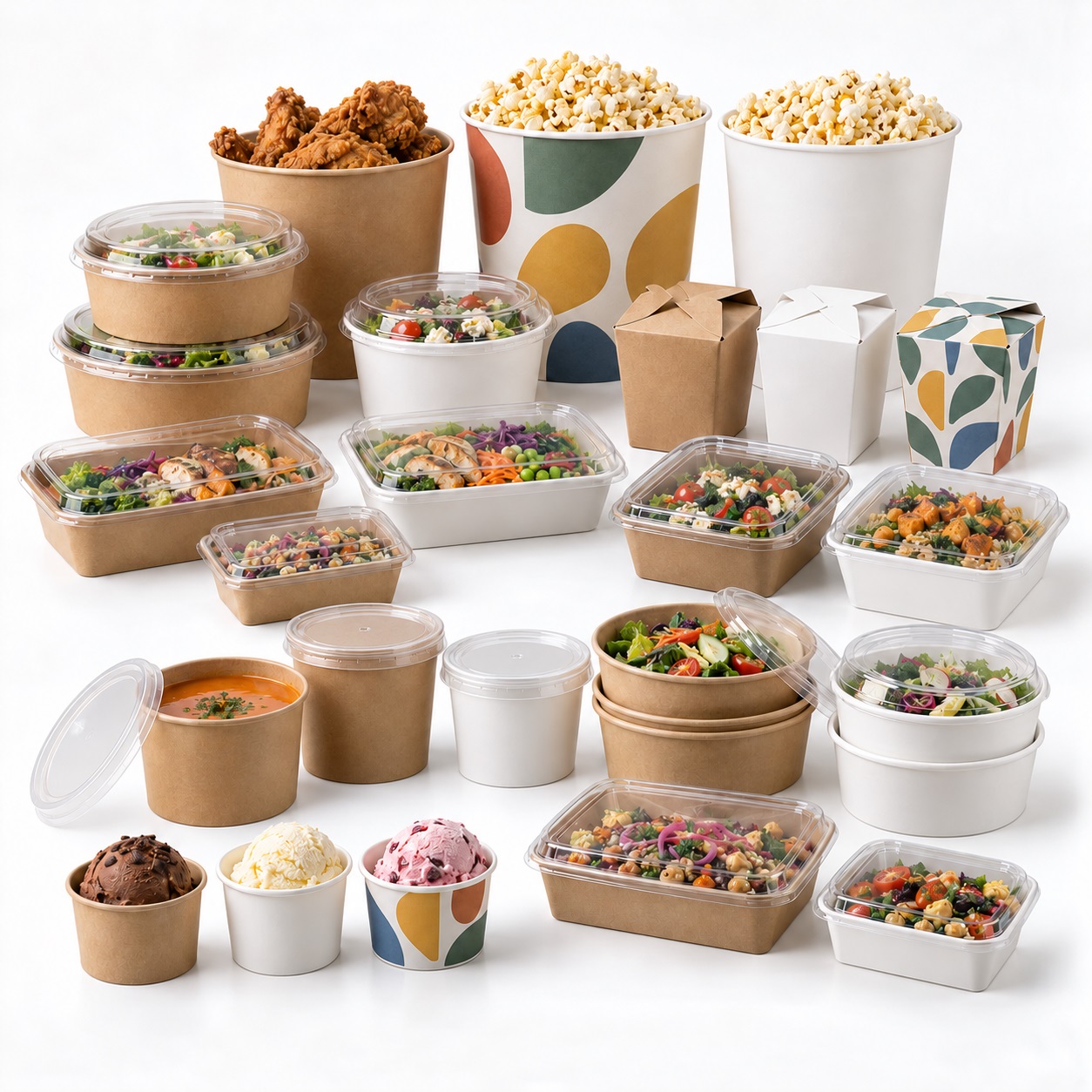
Paper food containers aren't a single type — they're a complete family serving every type of food:
- Salad and bowl containers — wide, open-mouth.
- Soup and hot food containers — deep, leak-proof lids.
- Ice cream and dessert cups — small, with lids.
- Noodle and Asian food boxes — square or rectangular.
- Compartment meal containers — with separate sections for protein, rice, and salad.
Plastic Is Retreating — Paper Is Advancing
In recent years, there's been a clear global shift from single-use plastic to paper alternatives. Restaurants and cafés across Europe, North Africa, and the Middle East are looking for paper alternatives for everything — from salad bowls to soup containers, from ice cream cups to food boxes.
This shift is driven by three factors:
- Environmental legislation in Europe and elsewhere limiting plastic.
- Consumer awareness — customers preferring sustainable packaging.
- Paper quality — which has now become competitive with plastic in performance and thermal insulation.
Why This Matters for Importers
An importer who masters importing food containers from Turkey today builds a foundation they can later expand to:
- Salad and bowl containers
- Soup and hot food containers
- Ice cream and dessert cups
- Noodle and Asian food boxes
- Compartment meals
- Container lids
- Everything converting from plastic to paper
In other words: You're not just importing a "container" — you're building a complete production line for the restaurants of the future.
📊 2. Why Turkey? An Honest Comparison
This question deserves a direct answer, not flattery. Here's the comparison as buyers actually see it:
| Criterion | Turkey | China | Europe |
|---|---|---|---|
| Shipping time | Days | Weeks | Days |
| Cost | Medium–Low | Very low | High |
| Print quality | High (flexo/offset) | Medium–High | Very high |
| Minimum order (MOQ) | Relatively flexible | High | High |
| Business communication | Easy | Medium | Easy |
| Food standards | FSC, ISO 22000 available | Variable | Strict |
| EU/Middle East market experience | High | Medium | High |
Why This Matters
Turkey isn't just a "cheap supplier." Turkey is:
- Geographically closer: to Europe, North Africa, and the Middle East than China. This means faster shipping, less capital tied up in inventory, and the ability to reorder quickly.
- Culturally and commercially closer: Communication is easier, negotiation clearer.
- Close to European quality: at 20–40% lower cost than European alternatives.
This is why Turkish packaging factories have become a primary supplier for restaurants across Europe, the Middle East, and North Africa over the past decade.
🔧 3. Technical Specs You Must Know Before Ordering
This section separates a buyer who knows what they want from one who sends "I want salad containers" and then gets surprised.
Types of Food Containers
| Type | Use | Specifications |
|---|---|---|
| Salad Bowl | Salads, bowls, healthy meals | Open mouth or with lid, large volume |
| Kraft Bowl | Salads, bowls | Natural look, for healthy brands |
| White Bowl | Salads, bowls | High print quality, clean look |
| Soup Container | Soups, hot meals | Deep, leak-proof lid, heat-resistant |
| Ice Cream Cup | Ice cream, desserts | Small size, with lid, inner coating |
| Noodle Box | Noodles, rice, Asian dishes | Square/rectangular, folding, with handle |
| Compartment Container | Full meals | 2-4 compartments, leak-proof lid |
| Hot Food Container | Hot meals | Heat-resistant, leak-proof lid |
Paper and Cardboard Type
| Type | Weight/Thickness | Best Use |
|---|---|---|
| Light Kraft | 250-300 gsm | Small salad bowls |
| Medium Kraft | 300-350 gsm | Large salad bowls |
| Heavy Kraft | 350-400 gsm | Hot food containers |
| White Paper | 280-350 gsm | Premium containers, high print quality |
| Corrugated (E-Flute) | ~1.5 mm | Large food containers |
Which to choose?
- For salads and bowls → Medium Kraft 300-350 gsm or White Paper.
- For soups and hot meals → Heavy Kraft 350-400 gsm with inner coating.
- For ice cream → White Paper 280-300 gsm.
Inner Coating
For food containers, inner coating is very important:
- PE Coating (Polyethylene): Resistant to grease and liquids — suitable for salads and soups.
- PLA Coating (Lactic Acid): Eco-friendly, biodegradable — suitable for the European market.
- Water-Based Coating: Plastic-free, eco-friendly — in demand in some markets.
- No Coating: Only for dry foods (rare).
Tip: If you're importing to the European market, PLA Coating or Water-Based Coating gives you a major competitive advantage.
Printing
- Flexo Printing: For large volumes, limited colors, lower cost.
- Offset Printing: For high quality, more colors, fine detail.
Practical tip: If you want a simple two-color logo, flexo is enough. If you want colorful designs or images on the container, you need offset.
Lids
Lids are an integral part of the container experience:
- Transparent Lid (PET): Shows the food, suitable for salads and bowls.
- Paper Lid: Eco-friendly, for the European market.
- Leak-Proof Lid: For soups and liquid foods.
- Dome Lid: For tall foods.
Tip: If you're importing to the European market, paper lids give you a major competitive advantage.
Certifications
- FSC (Forest Stewardship Council): Paper from environmentally responsible sources.
- ISO 22000: Food safety standards.
- BRCGS: British food packaging standard.
- OK Compost / DIN CERTCO: Industrial composting (important for Europe).
Always ask your supplier: "Do you have FSC certification for the specific product?" — not just "Is the factory certified?"
Sizes
Food containers come in various sizes:
- Small: 250-500 ml (ice cream, desserts)
- Medium: 500-750 ml (single salad, soup)
- Large: 750-1000 ml (large salad, meal)
- Extra Large: 1000-1500 ml (bowl, family meal)
- Custom: According to customer request
Tip: Always request a physical sample before ordering. Sizes vary from supplier to supplier.
🚚 4. The Practical Side: How to Import Smartly
Shipping — A Smart Comparison
- Turkey to Europe: Road freight (trucks) — faster and cheaper than sea freight from China.
- Turkey to North Africa and the Middle East: Short sea freight — days, not weeks.
- Turkey to the farthest point in the Arab world: Even the farthest distance remains shorter than a journey from China.
Golden rule: Food containers are bulky but light — which makes road freight ideal. Every day you save in shipping is capital not tied up in inventory.
Essential Documents
- Commercial Invoice
- Certificate of Origin
- Bill of Lading
- Packing List
- FSC certificate if available
- Health Certificate for food-contact products
Tip: To avoid customs delays, make sure your supplier sends documents correctly before shipping.
How to Choose the Right Supplier (Checklist)
- Request a physical sample (Golden Sample), not a photo. The sample tells you about real quality, paper thickness, inner coating quality, and container strength.
- Verify food safety certification for the specific product. Don't accept "the factory is certified" — ask for the product's own certificate.
- Ask about MOQ (Minimum Order Quantity). Turkish factories differ: some accept 1,000 containers, others 10,000.
- Ask about production lead time. Usually 15–30 days depending on quantity and printing.
- Ask about shipping time. Turkey to Europe: days. To North Africa: days.
- Request previous client references. A good supplier doesn't hide their clients.
- Verify Arabic printing capability. If you're importing to an Arab market, you need clear Arabic printing.
- Ask about compatible lids availability. A container without a proper lid = incomplete experience.
⚠️ 5. Common Mistakes That Cost Importers Money
- Ordering from a supplier not specialized in food containers. Regular paper isn't necessarily safe for hot foods.
- Ignoring shipping costs when comparing. Containers are bulky — shipping cost may be higher than expected.
- Not requesting a sample before ordering. 90% of problems appear in the sample.
- Relying only on product photos. Photos beautify. Samples don't lie.
- Not verifying certifications. If your supplier lacks FSC or ISO 22000, you may face problems with your clients.
- Importing large quantities before testing the market. Start small, test, then expand.
- Ignoring inner coating quality. A container with weak coating may start leaking minutes after pouring hot soup.
- Not testing the lid with the container. An incompatible lid may lead to leaks or a loose fit.
❓ 6. Frequently Asked Questions
How long does shipping from Turkey take?
Depends on the destination, but the rule is: Turkey is closer than China to Europe, North Africa, and the Middle East. Road freight to Europe takes days; sea freight to North Africa and the Middle East takes a few days.
Can I print Arabic on the containers?
Yes, but make sure the factory has experience with Arabic printing. Request a text sample before ordering.
What is the minimum order quantity?
It varies. Some factories accept 1,000 containers, others 5,000 or 10,000. Ask clearly.
Is Turkish paper approved for food use?
Yes, if the factory holds ISO 22000 and FSC. Request certificates in writing.
Can I get a sample before ordering?
Yes, most serious factories provide samples. You may only pay shipping cost.
What's the best payment method?
Bank transfer (T/T) is most common. Some factories accept LC (Letter of Credit) for large orders.
Are salad bowls suitable for hot foods?
Yes, if they're specifically made for hot foods and have suitable inner coating. Ask about container type and coating.
Are lids included with the containers?
Usually not. Lids are ordered separately, and you should ensure they fit the containers.
🚀 7. Summary: How to Start
- Define your need: Type, size, quantity, printing, lids.
- Find 3–5 suppliers in Turkey. Request samples.
- Compare: Quality, price, MOQ, shipping time, certifications.
- Test one sample before a large order.
- Start with a small quantity, then expand after success.
- Work with a customs broker in your country to ease procedures.
📩 For More Information, Contact Us: Paper Port
If you're looking for a trusted Turkish supplier for food containers — or any other paper food packaging products — you can start here:
The Paper Port team is ready to answer your questions, send samples, and prepare a custom quote within a short time.
— This guide is part of the "Importing Paper Food Packaging from Turkey" series — a series of articles aimed at helping importers, restaurants, and distributors make better purchasing decisions.
Comments (0)
Leave a Comment
You must login to comment.
No comments yet. Be the first to comment!